Friday, February 11, 2011

Some Days...

I’m writing this entry to let you know that although I love Nam, every day isn’t just a walk in the park. Some days are extremely challenging, especially those when I’m not getting anywhere in the classroom (and in grade 6, let me tell you, that happens a lot). On those days, I have to fill my head with positive messages just so I can make it through the school day. It goes something like this...

They’re not ignoring you, they just don’t understand. It’s not a constant undercurrent of chattering, they’re just translating for each other. Don’t worry, they’re just as frustrated as you are. They’re not trying to drive you crazy. It doesn’t mean they don’t like you. They’re not trying to annoy you or be disrespectful, they’re just floundering in a new situation. They’re still young and they’re not sure how to handle themselves when they’re confused or lost. They also don’t understand what you’re going through: that you left your friends and family thousands of miles away and gave up many comforts of home to come here and teach them. They’re adolescents, they haven’t yet developed the ability to empathize with others. They’re not trying to frustrate you so much that you leave, they’re just expressing their own frustration in the only way they know how. They want to understand you and they want to learn, they’re just scared of making mistakes. They’re not used to an environment where learning from your mistakes and others is encouraged and accepted. They have a lot on their plate; maybe they were cultivating in the fields all day yesterday or they didn’t eat anything this morning. You can do this, you are not wasting your time, it will work out.

Every job comes with its challenges and this is certainly no exception.

Monday, January 24, 2011

The First Days of School

The first week of school is over...and, let me tell you, the first week of school in Namibia is much different than the first week of school in America. In the States, students walk into classrooms decked out with posters and signs. They also already have an assigned seat and maybe even a name tag. They know who their teacher is and where their classroom is and they probably arrived at school early, just in case. Basically, students and teachers hit the ground running.


PHOTO: The walk to school looks a bit different these days, especially after an overnight rainfall.

In Namibia, the first week is more of an organizational period. During this time, students are transferring in or out of different schools. Teachers are meeting to figure out the time table (translation: class schedule). The school is waiting on supplies from the ministry (notebooks, chalk, crayons, copy paper) and from the school board (toner for the printer). Some of the supplies haven’t arrived yet...and never will.


PHOTO: A bit of water near my homestead (these are just baby oshanas!)

I didn’t actually teach a class until Thursday and ended up playing hangman on Friday because only 13 out of 35 grade 7s were present for English class (the last period of the day). Grade 5 didn’t have class all week because the teacher with their room key was away at a workshop. Thankfully, however, all the organization is now behind us; it’s now week two and the ball has started rolling...
The school’s newly formed library committee has also started meeting. We have many big tasks ahead of us (getting more books in both English and Oshindonga, rearranging the library’s space, cataloguing and organizing the books and teaching students how and why to use the library) but I am excited to get the project started.


PHOTO: Baby piglets on the homestead, born just a few weeks ago. Aren't they adorable!?

And, of course, a weather report. The rains have arrived and are hopefully here to stay. Although the rain creates big puddles everywhere and fills seasonal lakes called oshanas, I’m a fan of rainy days. It keeps things cooler and reminds me of a rainy (or snowy) day at home – the perfect time to dress in layers (which, to a Namibian-extent, I’ve done) and watch a movie in bed (check that off the list, too). Having to hike up my skirt or take off my shoes to walk to school is just a price I’ll have to pay in order to enjoy the benefits of the rain.

Monday, January 3, 2011

Christmas on the Beach

Alright I know it seems like I’ve completely dropped out of the blogosphere, but – don’t worry – I haven’t! I’ve just been on holiday, and it’s hard to keep a computer safe when you are traversing thousands of kilometres and camping in a tent so I just left it at home.


Photo: Trekking up Dune 7. Huge, isn't it??

First off, greetings: Merry Christmas and a Happy New Year to all! Also thanks to everyone who wished me a happy birthday and especially those that were forward-thinking enough to send a card in November (Grandma, Mom and Aunt Cheryl).


Photo: Our campsite in Swakop

As many of you may know, this is the first holiday season that I’ve ever spent away from home. And, honestly, I couldn’t be farther away from home (which turned out to be a good thing). It’s really hard to get homesick when it doesn’t feel like Christmas. And for me, there needs to be snow for it to feel like Christmas, so...Guess where I spent my Christmas? THE BEACH! It was great.


Photo: Cape Fur Seals - thousands of them. Oh the noises and the smells!

From the 24th of December to the 2nd of January, I camped with 20+ other volunteers in Swakopmund on the shores of the Atlantic Ocean. While everyone else at the campground had several cars, a few large tents, a braai (grill) and sometimes even a fridge, we had over 20 one- or two-person tents, laundry hanging everywhere and empty bottles and backpacks littering the ground. But who needs fancy camping equipment to have a good vacation?


Photo: Our Swakop group on the beach on the last day of 2010!

Swakop is one of Namibia’s biggest tourist destinations, especially during the holiday season. To be honest, it felt more like little Deutschland than Africa. I spent a lot of time on the beach – walking, reading, splashing around in the icy cold water (the Benguela Current pulls up chilly Antarctic water). And what time wasn’t spent at the beach was spent walking around the city and eating at its many delicious restaurants. After realizing that I’d be eating oshithima almost exclusively for the next three months, I decided I wanted to eat as much good food as possible. That meant sushi (x3), fish and chips (x2), carrot cake (x2), chocolate cake, milkshakes (x2), oysters (ick), pizza (x2), Chinese, gelato, and too many coffees and pastries to count. The damage to my wallet and my love handles is bound to be immense but frankly I don’t care. It was completely worth it.


Photo: Our Nam Christmas tree

Another highlight of the holiday was a trip up the Skeleton Coast (so named for the many whale and ship skeletons occupying its shores). With a group of 20 and two rented pickups, we visited Cape Cross, home to a huge Cape Fur Seal colony and Walvis Bay where we climbed Dune 7 (one of the largest in the world). We also camped on the beach next to a shipwreck (pretty sweet, right?).


Photo: Camping on the beach next to a shipwreck

Now, (fortunately or unfortunately – I’m not sure) it is time to return to reality, i.e. the village, and start the term. Time to speak Oshiwambo again...and eat oshithima...and mark papers...and measure time by looking at the sun. Generally, to do what I came here to do...


Photo: The view from Dune 7

Video: Dancing to Waka Waka on the beach...is this Africa?


Sunday, November 14, 2010

PICTURES!


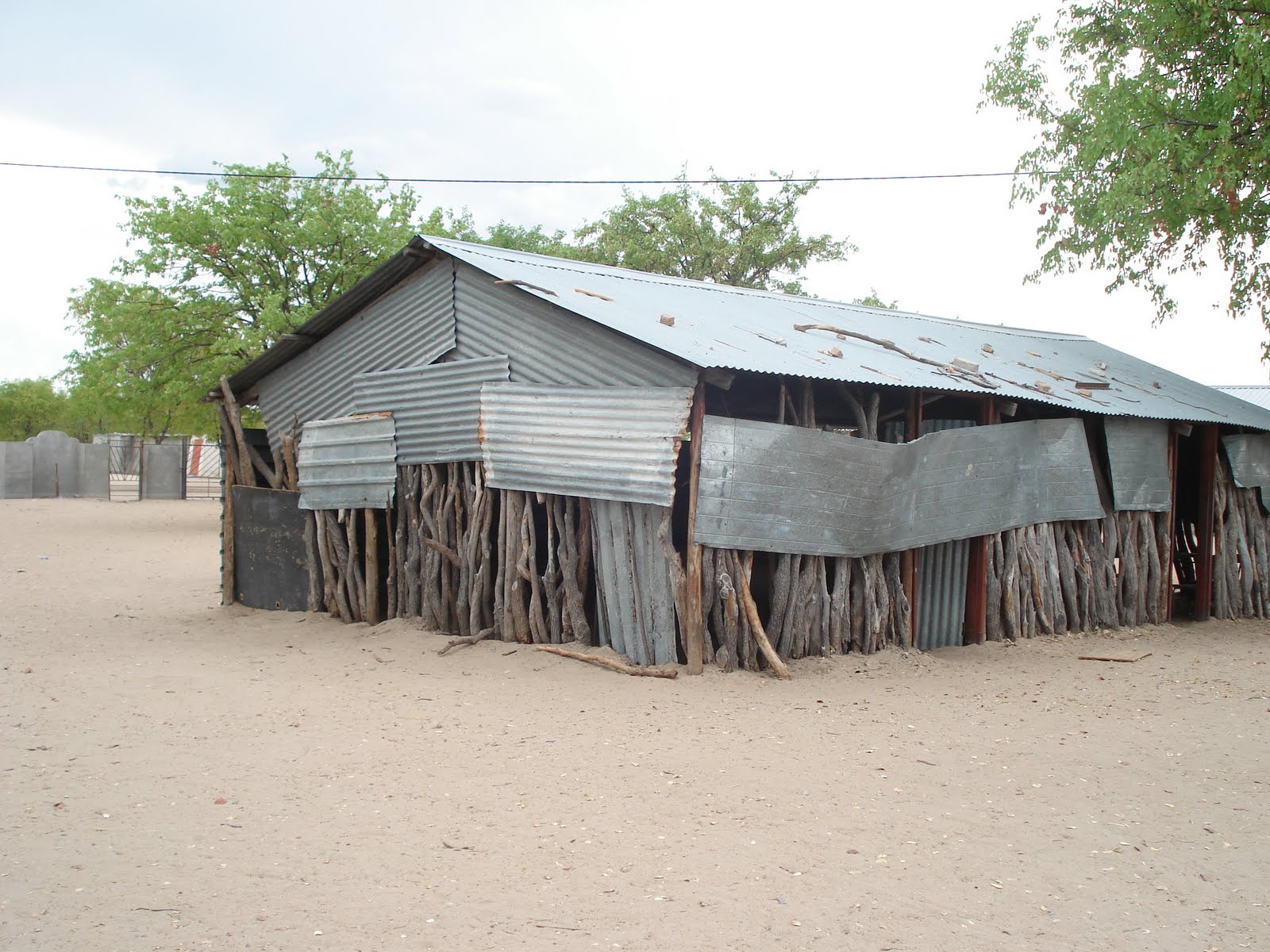
Inside of the Grade 8 classroom


My homestead (from a distance)


The Grade 9 and Grade 10 classrooms


Inside the principal's office (which is really the principal's office/library/media center/food storage area). There are 6 computers that don't work (to the right) and the white bags are maize meal supplied by the government so that they students can eat after school (a great program!)


The school's library


The office/storage closet that I share with 2 other teachers (yes, my desk is the one with nothing on it!)


Inside the Grade 6 classroom (yes, that is a goat that wandered inside the room)


The bush - this is what I see every day on my walk to and from school (and, I guess any time I want to go anywhere because this is the road that leads from the paved road deeper into the bush where the village is). You'll notice that it is quite green right now, which is something that has changed in the month that I've been here. It has only rained once but somehow things are getting greener!


A soccer goal (and you can see my homestead waaay in the background if you look hard)


A termite mound...and many goats


The Grade 7 classroom


Wednesday, November 3, 2010

"I'm paining..."

This one will be quick because I only have two things to say. First, I’m sorry for not getting these posts up in a timely manner. The network (translation: cell phone signal) is terrible here so I can’t even load my blog page at school. And (probably from a combination of the heat and the [internal] stress of living in another completely new environment) I’ve been really tired lately, meaning that I crash at about 9 PM and wake up for school at about 6:30. My motivation (and desire for that matter) to get up at 1 AM and stay up for a few hours during internet happy hour to wait ages for pages that may or may not load, is very minimal.


On the homestead at dusk with some of my (many) siblings: Tresia, Atu, Moses, Margarita, Sophia and (being held) Cassia.

Second, I got my first blisters from pounding mahangu. Before I started pounding, one of the girls relayed to me the message from my meme that I shouldn’t pound because I might hurt myself. We all had a good laugh at this one. What was I going to do? Drop the pounding stick on my foot? Ironically, this warning turned out to be quite prophetic. In a matter of 15 minutes I acquired 6 blisters, two of which opened up and are still stinging 12 hours later. I could have avoided getting so many blisters if I’d stopped after the first one appeared, but, in my stubbornness, I wanted to see the mahangu through to its flour-form finish. It’s quite amusing to show these blisters to my Namibian colleagues because they all squawk and tsk and shake their heads (quite literally, even the men). It was definitely worth it, though...and my hands will be much tougher for next time!


Tuesday, November 2, 2010

About Namibian Schools

I had a request (though my response is long overdue...sorry!) to talk a little bit about the schools in Namibia. Now, some of this might be a repeat from earlier, but please bear with me... And one more disclaimer, this is just based on my experience in the past 10 weeks. I’ve only seen a few different schools in a few different towns so I can’t speak for all of Namibia.

First, the school year. The school year begins in January and is split up into trimesters. Next school year, for example, the first term will begin January 13 and end April 21, the second will be May 16 through August 25 and the final term will begin September 5 and end on December 9. (For those you planning on visiting, COUGH CMEJLA NOEL ANITA COUGH, please take note). If a child is 6 years old by January 1, he/she can begin grade 1. For most purposes, the grades are split into four different levels: lower primary (grades 1-4), upper primary (grades 5-7), junior secondary (grades 8-10) and senior secondary (grades 11-12).

The language of instruction in the lower primary phase varies from region to region within the country, depending on what that region’s mothertongue is. For example, in Okahandja, where I stayed for the first two months, the children were taught in Afrikaans because it was an urban environment with a mix of different home languages. The language makeup where I am now is much more homogeneous, however, so Oshindonga (a dialect of Oshiwambo) is taught in primary school. Once students enter the upper primary grades, the mode of instruction changes to English. This means that although students still take a class in their mothertongue (similar to how English is taught in American schools all the way from kindergarten to high school), the rest of their subjects (math, science, life skills, phy ed, etc) are taught in English. As you can imagine, it is quite a change to switch from being taught (and tested) almost exclusively in Oshindonga one year to almost exclusively in English the next.

Okay, next topic: the daily school schedule. I’ll give you my school’s schedule, but I should also let you know that from what I’ve seen, my school is an exception to the general rule. Most schools start around 7 AM, with a staff meet that begins anywhere from 6:40 to 6:50. My school, on the other hand, doesn’t have a staff meeting in the morning and classes begin at 8 AM. If there is morning assembly (which there occasionally is on Mondays and Fridays although I haven’t yet figured out the method behind the madness as to when exactly an assembly is required and when it isn’t), it begins around 7:45 (though the bell for the assembly begins ringing a good 15 minutes before it actually begins, which is another story in itself...). Basically, morning assembly means that the kids line up by grade in the school yard, sing the national anthem and the school anthem, listen to a scripture reading, a prayer and any announcements the principal or other teachers might have. Once the assembly is done, the students are dismissed to first period, which is probably already “technically” in progress. Okay, so now back to the original topic: the schedule. Classes begin at 8 AM and are 40 minutes long. There are four periods before the tea break, which begins at 10:40 and ends at 11:10, and four periods after the break. This means that classes end at 1:50. From 1:50 to 2:30 (approximately, again, I’m a bit unsure on the actual times) there is another break and then afternoon study begins and continues until 4 PM when the school day is officially over.

Alright, now that the technical stuff is out of the way, the more practical items. Time, as you know, is much more flexible in Nam than it is in the US. For example, although tea break ends at 11:10, kids (and teachers) generally don’t start going back into their classrooms until 11:20, 11:30, maybe 11:40, depending on the day.

Ah, yes, another very important thing to understand...upper primary/junior secondary students are often (meaning, on average, once a day) left unattended here. In the US, leaving your class (even to go to the bathroom) is basically a capital offense. Not so much in Nam. If a teacher is sick, talking to the principal or a parent, marking (translation: grading) papers, planning lessons, invigilating (translation: proctoring) a nation-wide standardized exam or (yes, it has happened) in town at the bank because it’s pay day, the students are left to fend for themselves. Yes, I must admit, as an American-trained teacher (and student) I was very shocked by this at first. But, before you go and start passing judgment, let me tell you some of the amazing things that I’ve observed about these unattended classes: the students stick around and (generally) they manage to make it through the period without injuring each other or breaking school property. Imagine if a group of American 9th graders were left alone...after about 20 minutes, something would be vandalized and after about 30 minutes, half class would be walking around town, maybe headed to the nearest gas station to buy snacks. Am I completely off here?

This is getting quite long so I’ll cap this off with the system of promotion. Although I believe changes may be in the works (or things might have already been changed but have not yet filtered down?), students are only “allowed” to fail once per section. So, for example, Susie Student enters school and fails first grade. Susie then repeats grade one the next year but fails again. Since, however, a student can only fail once in grades 1-4, Susie is pushed on to grade 2 and then on to grade 3 (even if she fails grade 2). This same thing happens in the next section (grades 5-8). Once a student is in grade 10, this is where things really begin to count. In grade 10, if Susie gets enough “points” (based on grades in certain classes), she earns her Junior Secondary Certificate. After passing grade 10, Susie can apply begin grades 11-12 and, if her grades are good enough, she will be accepted. From grade 12 (after completion of the Senior Secondary Certificate), Susie can apply to attend a University. If Susie fails, she cannot retake grade 10 and does not earn her certificate. Her only choices, then, are to being working (usually on the family’s farm) or enroll in NamColl to begin work on what is basically a Nam equivalent of a GED.

One last thing before I sign off (I swear, this really is the last one), this system of passing/failing and other factors also leads to students of a wide range of ages being in the same grade. In grade 7, for example, the students might range in age from 12 to 19. Seriously! This also was quite a shock for me, coming from a school environment where student ages were very homogeneous.